Fonction de Landau
- Permutations
- Moyen
- Anecdotique
- Indication
- Solution
- MPSI
Indication

Solution
Source Typst
// sn-fctlandau — CC BY-SA 4.0 — https://jrax.fr/exos/sn/sn-fctlandau.html

// --- enonce ---
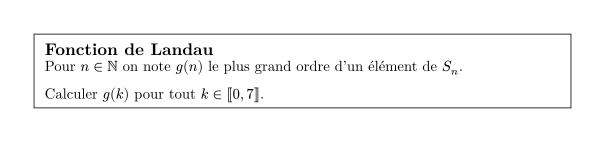
  Pour $n in NN$ on note $g(n)$ le plus grand ordre d'un élément de $S_n$.

  Calculer $g(k)$ pour tout $k in [| 0,7 |]$.


// --- indication ---
    On obtient 	$1$, $1$, $2$, $3$, $4$, $6$, $6$, $12$.


// --- solution ---
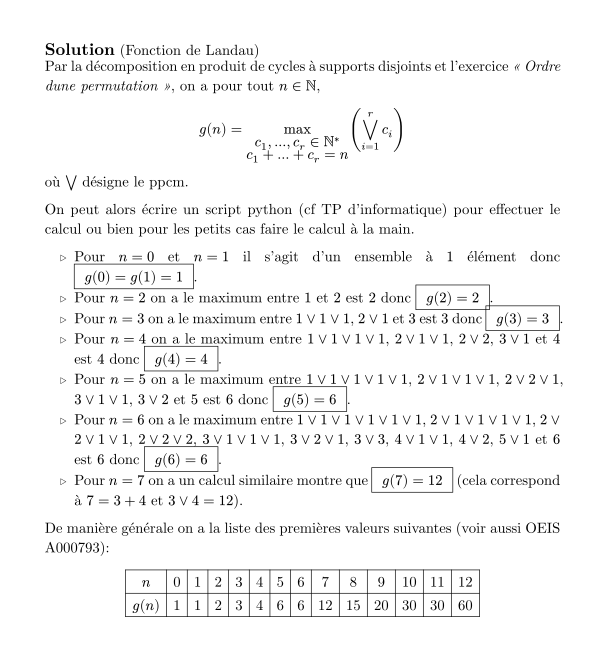
    Par la décomposition en produit de cycles à supports disjoints et l'exercice~#exoref("sn-ordre");, on a pour tout $n in NN$,

    $ g(n) = max_(scripts(#stack(dir: ttb, spacing: 0.25em, $c_1,...,c_r in NN^*$, $c_1+...+c_r=n$))) (or.big_(i=1)^r c_i) $
    où $or.big$ désigne le ppcm.

    On peut alors écrire un script python (cf TP d'informatique) pour effectuer le calcul ou bien pour les petits cas faire le calcul à la main.

    - Pour $n=0$ et $n=1$ il s'agit d'un ensemble à $1$ élément donc $boxed(g(0) = g(1) = 1)$.
    - Pour $n=2$ on a le maximum entre $1$ et $2$ est $2$ donc $boxed(g(2) = 2)$.
    - Pour $n=3$ on a le maximum entre $1 or 1 or 1$, $2or 1$ et $3$ est $3$ donc $boxed(g(3) = 3)$.
    - Pour $n=4$ on a le maximum entre $1 or 1 or 1 or 1$, $2or 1 or 1$, $2or 2$, $3or 1$ et $4$ est $4$ donc $boxed(g(4) = 4)$.
    - Pour $n=5$ on a le maximum entre $1 or 1 or 1 or 1 or 1$, $2or 1 or 1 or 1$, $2or 2 or 1$, $3or 1 or 1$, $3or 2$ et $5$ est $6$ donc $boxed(g(5) = 6)$.
    - Pour $n=6$ on a le maximum entre $1 or 1 or 1 or 1 or 1 or 1$, $2or 1 or 1 or 1 or 1$, $2or 2 or 1 or 1$, $2or 2 or 2$, $3or 1 or 1 or 1$, $3or 2 or 1$, $3or 3$, $4or 1 or 1$, $4or 2$, $5or 1$ et $6$ est $6$ donc $boxed(g(6) = 6)$.
    - Pour $n=7$ on a un calcul similaire montre que $boxed(g(7) = 12)$ (cela correspond à $7 = 3 + 4$ et $3 or 4 = 12$).

    De manière générale on a la liste des premières valeurs suivantes (voir aussi #link("https://oeis.org/A000793")[OEIS A000793];):

    #align(center)[
      #table(
        columns: 14,
        align: (
          center,
          center,
          center,
          center,
          center,
          center,
          center,
          center,
          center,
          center,
          center,
          center,
          center,
          center,
        ),
        stroke: 0.5pt,
        [$n$], [0], [1], [2], [3], [4], [5], [6], [7], [8], [9], [10], [11], [12],
        [$g(n)$], [1], [1], [2], [3], [4], [6], [6], [12], [15], [20], [30], [30], [60],
      )
    ]
Une remarque ?
Une coquille, une erreur, une question sur cet exercice ?
Message envoyé, merci !
L'envoi a échoué — vous pouvez écrire à contact@jrax.fr.
Réponse à la question anti-robot incorrecte — le message n'a pas été envoyé (revenez en arrière pour retrouver votre saisie).