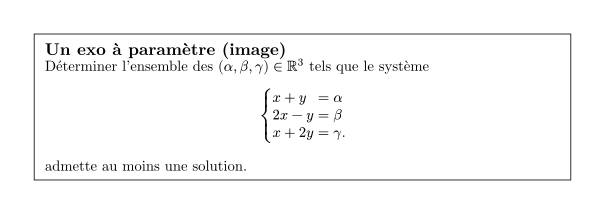
Un exo à paramètre (image)
- Matrices sans Algèbre Linéaire
- Rapide
- Classique
- Solution
- MPSI
- PCSI
- systèmes linéaires
Solution
Source Typst
// matsansalglin-img — CC BY-SA 4.0 — https://jrax.fr/exos/matsansalglin/matsansalglin-img.html

// --- enonce ---
    Déterminer l'ensemble des $(alpha,beta,gamma) in RR^3$ tels que le système

    $
      cases(
        x + y & = alpha,
        2 x - y & = beta,
        x + 2 y & = gamma.
      )
    $
    admette au moins une solution.


// --- solution ---
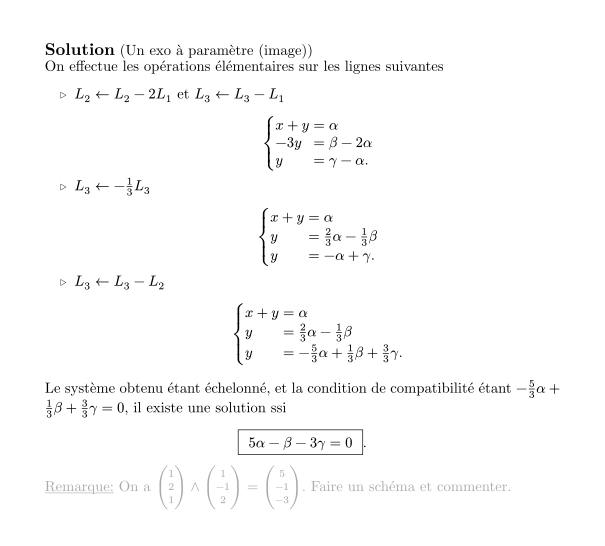
    On effectue les opérations élémentaires sur les lignes suivantes

    - $L_2 <- L_2 - 2 L_1$ et $L_3 <- L_3 - L_1$

      $
        cases(
          x + y & = alpha,
          - 3y & = beta-2 alpha,
          y & = gamma -alpha.
        )
      $
    - $L_3 <- -frac(1, 3)L_3$

      $
        cases(
          x + y & = alpha,
          y & = frac(2, 3)alpha - frac(1, 3) beta,
          y & = -alpha + gamma.
        )
      $
    - $L_3 <- L_3 - L_2$

      $
        cases(
          x + y & = alpha,
          y & = frac(2, 3)alpha - frac(1, 3) beta,
          y & = -frac(5, 3)alpha +frac(1, 3)beta + frac(3, 3) gamma.
        )
      $

    Le système obtenu étant échelonné, et la condition de compatibilité étant $-frac(5, 3)alpha +frac(1, 3)beta + frac(3, 3) gamma = 0$, il existe une solution ssi
    $ boxed(5 alpha - beta -3 gamma = 0). $

    #text(
      fill: gray,
    )[#underline[Remarque:] On a $mat(1; 2; 1) and mat(1; - 1; 2) = mat(5; - 1; -3)$. Faire un schéma et commenter.]
Une remarque ?
Une coquille, une erreur, une question sur cet exercice ?
Message envoyé, merci !
L'envoi a échoué — vous pouvez écrire à contact@jrax.fr.
Réponse à la question anti-robot incorrecte — le message n'a pas été envoyé (revenez en arrière pour retrouver votre saisie).