TD Structure algébriques: Une construction matricielle des complexes
- Matrices sans Algèbre Linéaire
- Rapide
- Essentiel
- Solution
- MPSI
- matrices remarquables
Solution
Source Typst
// matsansalglin-cmat — CC BY-SA 4.0 — https://jrax.fr/exos/matsansalglin/matsansalglin-cmat.html

// --- enonce ---
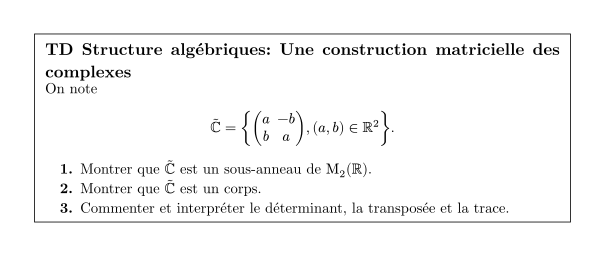
    On note
    $ tilde(CC) = {mat(a, -b; b, a), (a, b) in RR^2}. $
    + Montrer que $tilde(CC)$ est un sous-anneau de $op("M")_2(RR)$.
    + Montrer que $tilde(CC)$ est un corps.
    + Commenter et interpréter le déterminant, la transposée et la trace.


// --- solution ---
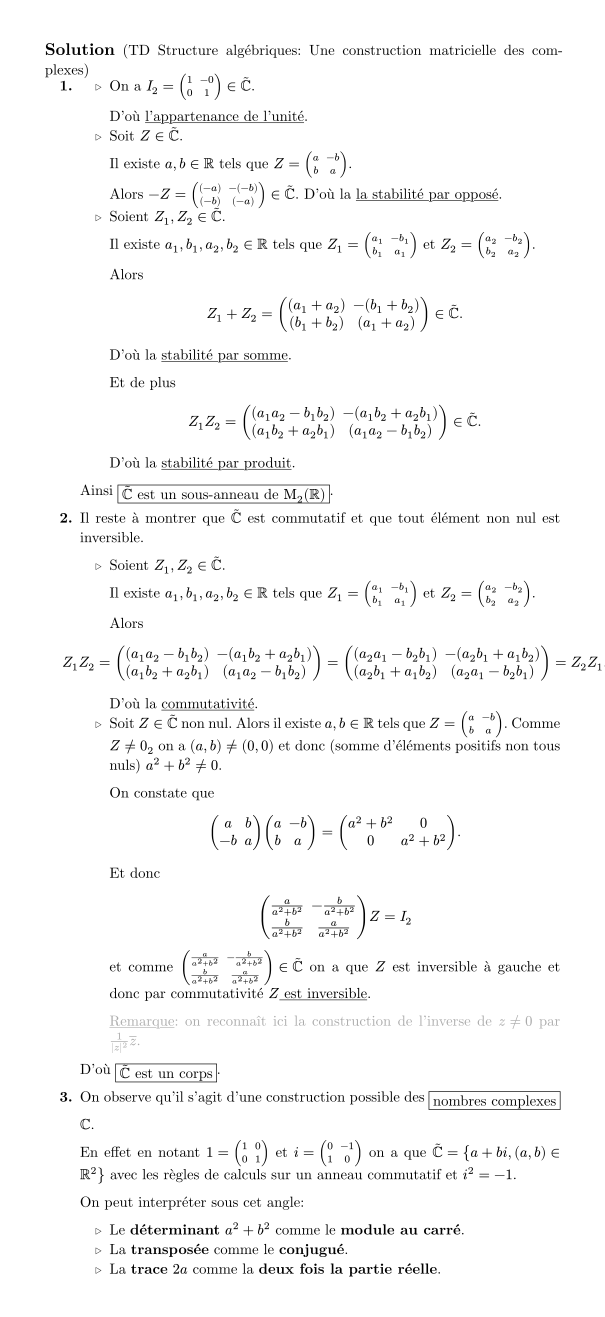
    + - On a $I_2 = mat(1, - 0; 0, 1) in tilde(CC)$.

        D'où #underline[l'appartenance de l'unité].
      - Soit $Z in tilde(CC)$.

        Il existe $a,b in RR$ tels que $Z = mat(a, - b; b, a)$.

        Alors $-Z = mat((-a), -(-b); (-b), (-a)) in tilde(CC)$. D'où la #underline[la stabilité par opposé].
      - Soient $Z_1,Z_2 in tilde(CC)$.

        Il existe $a_1,b_1,a_2,b_2 in RR$ tels que $Z_1 = mat(a_1, - b_1; b_1, a_1)$ et $Z_2 = mat(a_2, - b_2; b_2, a_2)$.

        Alors

        $ Z_1 + Z_2 = mat((a_1 + a_2), - (b_1 + b_2); (b_1 + b_2), (a_1 + a_2)) in tilde(CC). $

        D'où la #underline[stabilité par somme].

        Et de plus

        $
          Z_1 Z_2 = mat((a_1 a_2 - b_1 b_2), - (a_1 b_2 + a_2 b_1); (a_1 b_2 + a_2 b_1), (a_1 a_2 - b_1 b_2)) in tilde(CC).
        $

        D'où la #underline[stabilité par produit].

      Ainsi #fbox[$tilde(CC)$ est un sous-anneau de $op("M")_2(RR)$].
    + Il reste à montrer que $tilde(CC)$ est commutatif et que tout élément non nul est inversible.


      - Soient $Z_1,Z_2 in tilde(CC)$.

        Il existe  $a_1,b_1,a_2,b_2 in RR$ tels que $Z_1 = mat(a_1, - b_1; b_1, a_1)$ et $Z_2 = mat(a_2, - b_2; b_2, a_2)$.

        Alors

        $
          Z_1 Z_2 = mat((a_1 a_2 - b_1 b_2), - (a_1 b_2 + a_2 b_1); (a_1 b_2 + a_2 b_1), (a_1 a_2 - b_1 b_2)) = mat((a_2 a_1 - b_2 b_1), - (a_2 b_1 + a_1 b_2); (a_2 b_1 + a_1 b_2), (a_2 a_1 - b_2 b_1)) = Z_2 Z_1.
        $

        D'où la #underline[commutativité].
      - Soit $Z in tilde(CC)$ non nul. Alors il existe $a,b in RR$ tels que $Z = mat(a, - b; b, a)$. Comme $Z != 0_2$ on a $(a,b) != (0,0)$ et donc (somme d'éléments positifs non tous nuls) $a^2 + b^2 != 0$.

        On constate que

        $ mat(a, b; -b, a) mat(a, - b; b, a) = mat(a^2 + b^2, 0; 0, a^2 + b^2). $

        Et donc

        $ mat(frac(a, a^2+b^2), - frac(b, a^2 + b^2); frac(b, a^2 + b^2), frac(a, a^2 + b^2)) Z = I_2 $

        et comme $mat(frac(a, a^2+b^2), - frac(b, a^2 + b^2); frac(b, a^2 + b^2), frac(a, a^2 + b^2)) in tilde(CC)$ on a que $Z$ est inversible à gauche et donc par commutativité #underline[$Z$ est inversible].

        #text(
          fill: gray,
        )[#underline[Remarque]: on reconnaît ici la construction de l'inverse de $z != 0$ par $frac(1, |z|^2) overline(z)$.]

      D'où #fbox[$tilde(CC)$ est un corps].
    + On observe qu'il s'agit d'une construction possible des #fbox[nombres complexes] $CC$.

      En effet en notant $1 = mat(1, 0; 0, 1)$ et $i = mat(0, -1; 1, 0)$ on a que $tilde(CC) = { a + b i, (a,b) in RR^2 }$ avec les règles de calculs sur un anneau commutatif et $i^2 = -1$.


      On peut interpréter sous cet angle:

      - Le #strong[déterminant] $a^2 + b^2$ comme le #strong[module au carré].
      - La #strong[transposée] comme le #strong[conjugué].
      - La #strong[trace] $2a$ comme la #strong[deux fois la partie réelle].
Une remarque ?
Une coquille, une erreur, une question sur cet exercice ?
Message envoyé, merci !
L'envoi a échoué — vous pouvez écrire à contact@jrax.fr.
Réponse à la question anti-robot incorrecte — le message n'a pas été envoyé (revenez en arrière pour retrouver votre saisie).