Traduction I
- Logique
- Rapide
- Standard
- Indication
- Solution
- MPSI
- PCSI
- formalisme
- manipulation formelle
Indication
Solution

Source Typst
// logique-tradi — CC BY-SA 4.0 — https://jrax.fr/exos/logique/logique-tradi.html

// --- enonce ---
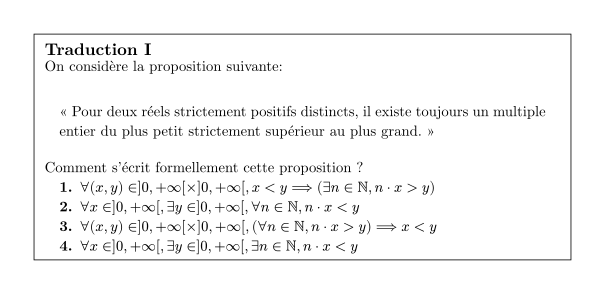
    On considère la proposition suivante:
    #quote(block: true)[
      «~Pour deux réels strictement positifs distincts, il existe toujours un multiple entier du plus petit strictement supérieur au plus grand.~»
    ]
    Comment s'écrit formellement cette proposition ?
    + $forall (x,y) in ]0,+infinity[ times ]0,+infinity[, x<y ==> ( exists n in NN, n dot.op x >y )$
    + $forall x in ]0,+infinity[, exists y in ]0,+infinity[, forall n in NN, n dot.op x < y$
    + $forall (x,y) in ]0,+infinity[ times ]0,+infinity[,( forall n in NN, n dot.op x >y ) ==> x<y$
    + $forall x in ]0,+infinity[, exists y in ]0,+infinity[, exists n in NN, n dot.op x < y$


// --- indication ---
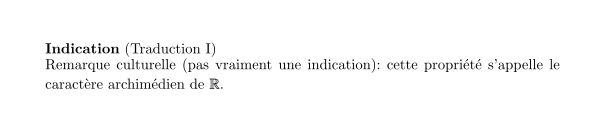
    Remarque culturelle (pas vraiment une indication): cette propriété s'appelle le caractère archimédien de $RR$.


// --- solution ---
    Il s'agit de la proposition #fbox[n°1].
Une remarque ?
Une coquille, une erreur, une question sur cet exercice ?
Message envoyé, merci !
L'envoi a échoué — vous pouvez écrire à contact@jrax.fr.
Réponse à la question anti-robot incorrecte — le message n'a pas été envoyé (revenez en arrière pour retrouver votre saisie).