NAND et NOR
- Logique
- Rapide
- Anecdotique
- Indication
- Solution
- MPSI
- PCSI
- manipulation formelle
Indication

Solution
Source Typst
// logique-nandnor — CC BY-SA 4.0 — https://jrax.fr/exos/logique/logique-nandnor.html

// --- enonce ---
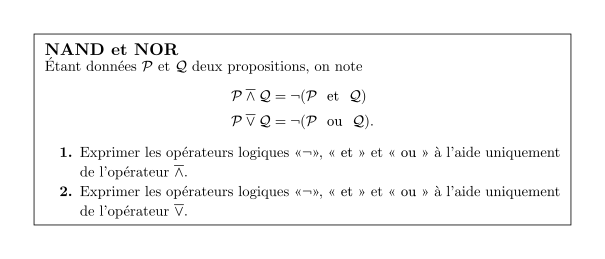
    Étant données $cal(P)$ et $cal(Q)$ deux propositions, on note
    $
      cal(P)overline(and) cal(Q) & = not (cal(P) " et " cal(Q)) \
       cal(P)overline(or) cal(Q) & = not (cal(P) " ou " cal(Q)).
    $
    + Exprimer les opérateurs logiques «$not$», «$" et "$» et «$" ou "$» à l'aide uniquement de l'opérateur $overline(and)$.
    + Exprimer les opérateurs logiques «$not$», «$" et "$» et «$" ou "$» à l'aide uniquement de l'opérateur $overline(or)$.


// --- indication ---
    Commencer par exprimer $not$, le reste suit par les règles de calcul.


// --- solution ---
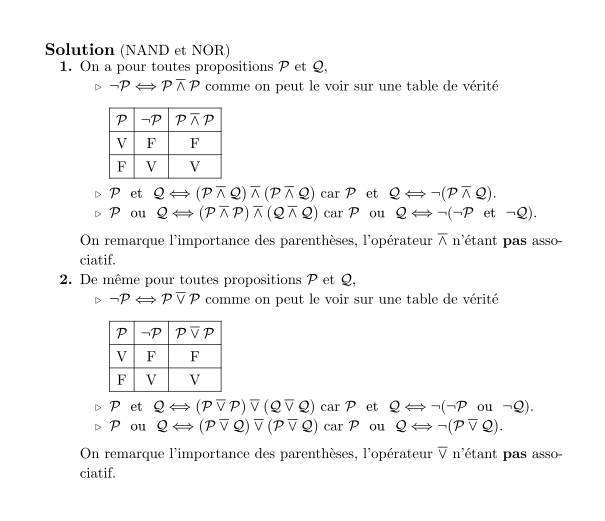
    + On a pour toutes propositions $cal(P)$ et $cal(Q)$,
      - $not cal(P)<==>cal(P) overline(and) cal(P)$ comme on peut le voir sur une table de vérité
        #table(
          columns: 3,
          align: (center, center, center),
          stroke: 0.5pt,
          [$cal(P)$], [$not cal(P)$], [$cal(P) overline(and) cal(P)$],
          [V], [F], [F],
          [F], [V], [V],
        )
      - $cal(P) " et " cal(Q)<==>(cal(P) overline(and) cal(Q)) overline(and) (cal(P) overline(and) cal(Q))$
        car $cal(P) " et " cal(Q)<==>not (cal(P) overline(and) cal(Q))$.
      - $cal(P) " ou " cal(Q)<==>(cal(P) overline(and) cal(P)) overline(and) (cal(Q) overline(and) cal(Q))$
        car $cal(P) " ou " cal(Q)<==>not (not cal(P) " et " not cal(Q))$.
      On remarque l'importance des parenthèses, l'opérateur $overline(and)$ n'étant #strong[pas] associatif.
    + De même pour toutes propositions $cal(P)$ et $cal(Q)$,
      - $not cal(P)<==>cal(P) overline(or) cal(P)$ comme on peut le voir sur une table de vérité
        #table(
          columns: 3,
          align: (center, center, center),
          stroke: 0.5pt,
          [$cal(P)$], [$not cal(P)$], [$cal(P) overline(or) cal(P)$],
          [V], [F], [F],
          [F], [V], [V],
        )
      - $cal(P) " et " cal(Q)<==>(cal(P) overline(or) cal(P)) overline(or) (cal(Q) overline(or) cal(Q))$
        car $cal(P) " et " cal(Q)<==>not (not cal(P) " ou " not cal(Q))$.
      - $cal(P) " ou " cal(Q)<==>(cal(P) overline(or) cal(Q)) overline(or) (cal(P) overline(or) cal(Q))$
        car $cal(P) " ou " cal(Q)<==>not (cal(P) overline(or) cal(Q))$.
      On remarque l'importance des parenthèses, l'opérateur $overline(or)$ n'étant #strong[pas] associatif.
Une remarque ?
Une coquille, une erreur, une question sur cet exercice ?
Message envoyé, merci !
L'envoi a échoué — vous pouvez écrire à contact@jrax.fr.
Réponse à la question anti-robot incorrecte — le message n'a pas été envoyé (revenez en arrière pour retrouver votre saisie).