Dérivées en plus du cahier de calculs
- Fonctions Usuelles
- Rapide
- Standard
- Indication
- MPSI
- PCSI
- trigonométrie hyperbolique
Indication

Source Typst
// fonc-usu-calcderiv — CC BY-SA 4.0 — https://jrax.fr/exos/fonc-usu/fonc-usu-calcderiv.html

// --- enonce ---
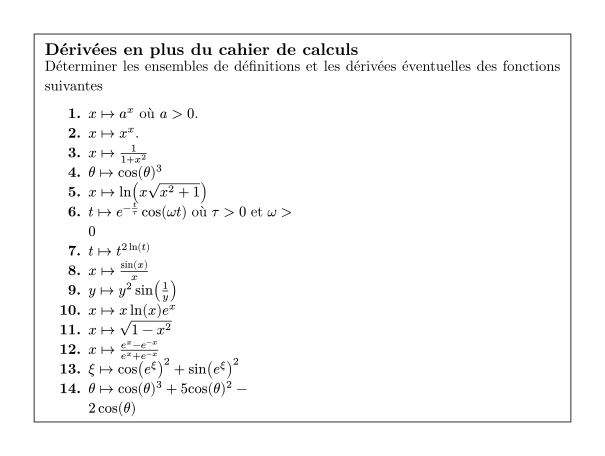
    Déterminer les ensembles de définitions et les dérivées éventuelles des fonctions suivantes
    #columns(2)[
      + $x mapsto a^x$ où $a>0$.
      + $x mapsto x^x$.
      + $x mapsto frac(1, 1+x^2)$
      + $theta mapsto cos(theta)^3$
      + $x mapsto ln(x sqrt(x^2+1))$
      + $t mapsto e^(-frac(t, tau)) cos(omega t)$ où $tau > 0$ et $omega > 0$
      + $t mapsto t^(2 ln(t))$
      + $x mapsto frac(sin(x), x)$
      + $y mapsto y^2 sin (frac(1, y))$
      + $x mapsto x ln(x) e^x$
      + $x mapsto sqrt(1-x^2)$
      + $x mapsto frac(e^x-e^(-x), e^x + e^(-x))$
      + $xi mapsto cos(e^xi)^2 + sin(e^xi)^2$
      + $theta mapsto cos(theta)^3 +5 cos(theta)^2 -2 cos(theta)$
    ]


// --- indication ---
    RAS sinon de *simplifier* avant de calculer.
Une remarque ?
Une coquille, une erreur, une question sur cet exercice ?
Message envoyé, merci !
L'envoi a échoué — vous pouvez écrire à contact@jrax.fr.
Réponse à la question anti-robot incorrecte — le message n'a pas été envoyé (revenez en arrière pour retrouver votre saisie).