Équations à coefficients constants avec second membre
- Équations Différentielles Ordinaires
- Rapide
- Classique
- Solution
- MPSI
- PCSI
- calcul
Solution
Source Typst
// edos-ed1cc — CC BY-SA 4.0 — https://jrax.fr/exos/edos/edos-ed1cc.html

// --- enonce ---
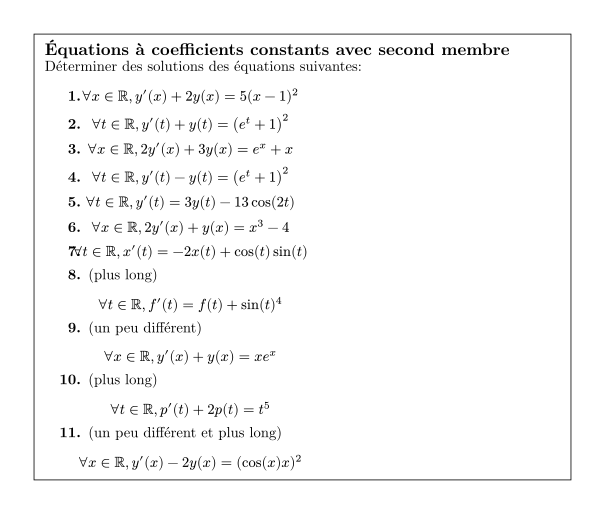
    Déterminer des solutions des équations suivantes:
    #columns(2)[
      + $ forall x in RR, y'(x) + 2 y(x)=5(x-1)^2 $
      + $ forall t in RR, y'(t) + y(t)=(e^t+1)^2 $
      + $ forall x in RR, 2 y'(x)+3 y(x) = e^x + x $
      + $ forall t in RR, y'(t) - y(t)=(e^t+1)^2 $
      + $ forall t in RR, y'(t)= 3 y(t) -13 cos(2t) $
      + $ forall x in RR, 2 y'(x)+y(x) = x^3-4 $
      + $ forall t in RR, x'(t) = -2x(t) + cos(t)sin(t) $
      + (plus long)
        $ forall t in RR, f'(t) = f(t) + sin(t)^4 $
      + (un peu différent)
        $ forall x in RR, y'(x)+y(x) = x e^x $
      + (plus long)
        $ forall t in RR, p'(t)+2 p(t) = t^5 $
      + (un peu différent et plus long)
        $ forall x in RR, y'(x)-2 y(x) = (cos(x) x)^2 $
    ]


// --- solution ---
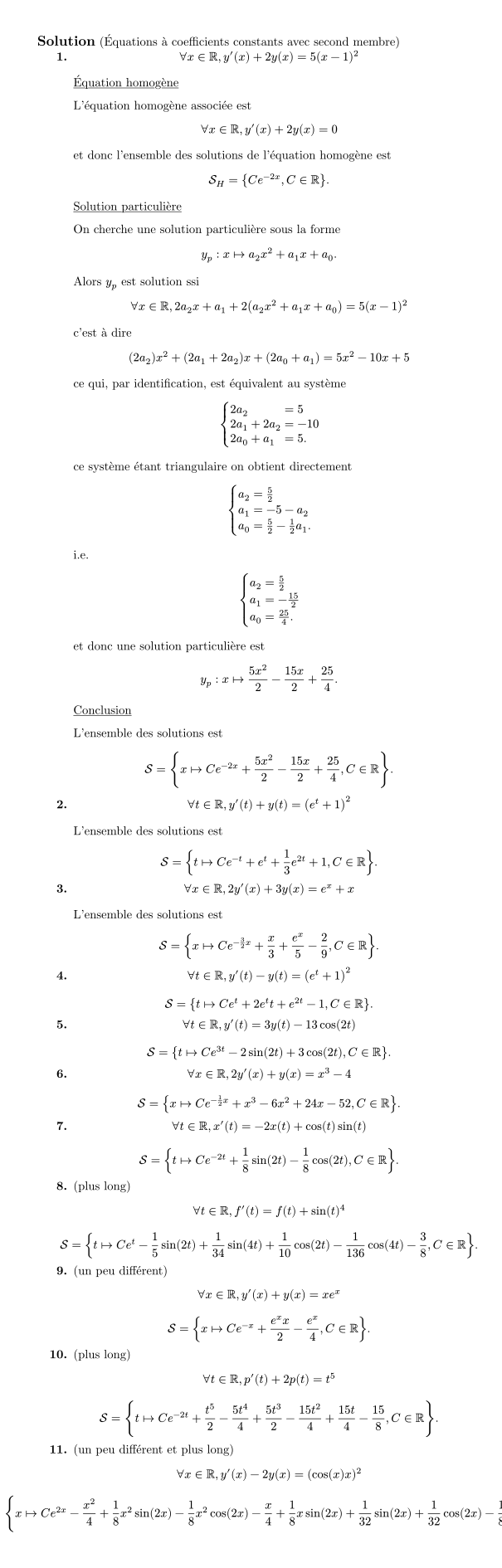
    + $ forall x in RR, y'(x) + 2 y(x)=5(x-1)^2 $
      #underline[Équation homogène]

      L'équation homogène associée est
      $ forall x in RR, y'(x) + 2 y(x)=0 $
      et donc l'ensemble des solutions de l'équation homogène est
      $ cal(S)_H = { C e^(-2x) , C in RR}. $

      #underline[Solution particulière]

      On cherche une solution particulière sous la forme

      $ y_p: x mapsto a_2 x^2 +a_1 x +a_0. $

      Alors $y_p$ est solution ssi
      $ forall x in RR, 2 a_2 x + a_1 + 2 (a_2 x^2 +a_1 x +a_0) = 5(x-1)^2 $
      c'est à dire
      $ (2a_2) x^2 + (2a_1 + 2 a_2) x + (2a_0 + a_1) = 5 x^2 - 10x +5 $
      ce qui, par identification, est équivalent au système
      $
        cases(
          2 a_2 & = 5,
          2a_1 + 2a_2 & = -10,
          2a_0+a_1 & = 5.
        )
      $
      ce système étant triangulaire on obtient directement
      $
        cases(
          a_2 & = frac(5, 2),
          a_1 & = -5-a_2,
          a_0 & = frac(5, 2) - frac(1, 2) a_1.
        )
      $
      i.e.
      $
        cases(
          a_2 & = frac(5, 2),
          a_1 & = -frac(15, 2),
          a_0 & = frac(25, 4).
        )
      $
      et donc une solution particulière est
      $ y_p : x mapsto frac(5 x^2, 2)-frac(15 x, 2)+frac(25, 4). $

      #underline[Conclusion]

      L'ensemble des solutions est
      $ cal(S) = {x mapsto C e^(-2 x)+frac(5 x^2, 2)-frac(15 x, 2)+frac(25, 4), C in RR}. $
    + $ forall t in RR, y'(t) + y(t)=(e^t+1)^2 $
      L'ensemble des solutions est
      $ cal(S) = {t mapsto C e^(-t)+e^t + frac(1, 3)e^(2 t ) +1, C in RR}. $
    + $ forall x in RR, 2 y'(x)+3 y(x) = e^x + x $
      L'ensemble des solutions est
      $ cal(S) = {x mapsto C e^(-frac(3, 2) x)+frac(x, 3)+frac(e^x, 5)-frac(2, 9), C in RR}. $
    + $ forall t in RR, y'(t) - y(t)=(e^t+1)^2 $
      $ cal(S) = {t mapsto C e^(t)+ 2 e^t t + e^(2t) - 1, C in RR}. $
    + $ forall t in RR, y'(t)= 3 y(t) -13 cos(2t) $
      $ cal(S) = {t mapsto C e^(3t)-2 sin(2t)+3 cos(2t), C in RR}. $
    + $ forall x in RR, 2 y'(x)+y(x) = x^3-4 $
      $ cal(S) = {x mapsto C e^(-frac(1, 2) x)+x^3-6x^2+24x - 52, C in RR}. $
    + $ forall t in RR, x'(t) = -2x(t) + cos(t)sin(t) $
      $ cal(S) = {t mapsto C e^(-2t)+frac(1, 8) sin(2t) - frac(1, 8) cos(2t), C in RR}. $
    + (plus long)
      $ forall t in RR, f'(t) = f(t) + sin(t)^4 $
      $
        cal(S) = {t mapsto C e^t-frac(1, 5) sin (2 t)+frac(1, 34) sin (4 t)+frac(1, 10) cos (2 t)-frac(1, 136) cos (4 t)-frac(3, 8), C in RR}.
      $
    + (un peu différent)
      $ forall x in RR, y'(x)+y(x) = x e^x $
      $ cal(S) = {x mapsto C e^(-x)+frac(e^x x, 2)-frac(e^x, 4), C in RR}. $
    + (plus long)
      $ forall t in RR, p'(t)+2 p(t) = t^5 $
      $
        cal(S) = {t mapsto C e^(-2 t)+frac(t^5, 2)-frac(5 t^4, 4)+frac(5 t^3, 2)-frac(15 t^2, 4)+frac(15 t, 4)-frac(15, 8), C in RR}.
      $
    + (un peu différent et plus long)
      $ forall x in RR, y'(x)-2 y(x) = (cos(x) x)^2 $
      $
        cal(S) = {x mapsto C e^(2 x)-frac(x^2, 4)+frac(1, 8) x^2 sin (2 x)-frac(1, 8) x^2 cos (2 x)-frac(x, 4)+frac(1, 8) x sin (2 x)+frac(1, 32) sin (2x)+frac(1, 32) cos (2 x)-frac(1, 8), C in RR}.
      $
Une remarque ?
Une coquille, une erreur, une question sur cet exercice ?
Message envoyé, merci !
L'envoi a échoué — vous pouvez écrire à contact@jrax.fr.
Réponse à la question anti-robot incorrecte — le message n'a pas été envoyé (revenez en arrière pour retrouver votre saisie).