Il y a du Vandermonde derrière
- Déterminants
- Long
- Anecdotique
- Indication
- MPSI
- plusieurs étapes
- vandermonde
Indication
Source Typst
// det-vdmprod — CC BY-SA 4.0 — https://jrax.fr/exos/det/det-vdmprod.html

// --- enonce ---
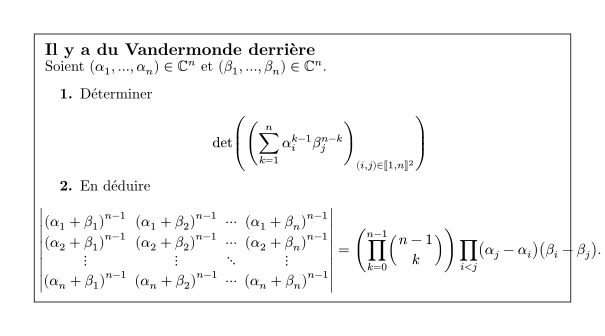
    Soient $(alpha_1,dots.h,alpha_n) in CC^n$ et $(beta_1,dots.h,beta_n) in CC^n$.

    + Déterminer
      $ det((sum_(k=1)^n alpha_i^(k-1) beta_j^(n-k))_((i,j)in [|1,n|]^2)) $
    + En déduire
      $
        mat(delim: "|", (alpha_1+beta_1)^(n-1), (alpha_1+beta_2)^(n-1), dots.c, (alpha_1+beta_n)^(n-1); (alpha_2+beta_1)^(n-1), (alpha_2+beta_2)^(n-1), dots.c, (alpha_2+beta_n)^(n-1); dots.v, dots.v, dots.down, dots.v; (alpha_n+beta_1)^(n-1), (alpha_n+beta_2)^(n-1), dots.c, (alpha_n+beta_n)^(n-1)) = (product_(k=0)^(n-1) binom(n-1, k)) product_(i<j) (alpha_j - alpha_i)(beta_i - beta_j) .
      $


// --- indication ---
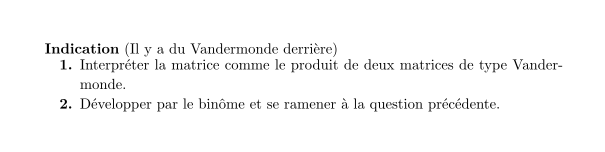
    + Interpréter la matrice comme le produit de deux matrices de type Vandermonde.
    + Développer par le binôme et se ramener à la question précédente.
Une remarque ?
Une coquille, une erreur, une question sur cet exercice ?
Message envoyé, merci !
L'envoi a échoué — vous pouvez écrire à contact@jrax.fr.
Réponse à la question anti-robot incorrecte — le message n'a pas été envoyé (revenez en arrière pour retrouver votre saisie).