Encore des calculs de déterminants
- Déterminants
- Moyen
- Anecdotique
- Indication
- MPSI
- PCSI
Indication
Source Typst
// det-calcdet2 — CC BY-SA 4.0 — https://jrax.fr/exos/det/det-calcdet2.html

// --- enonce ---
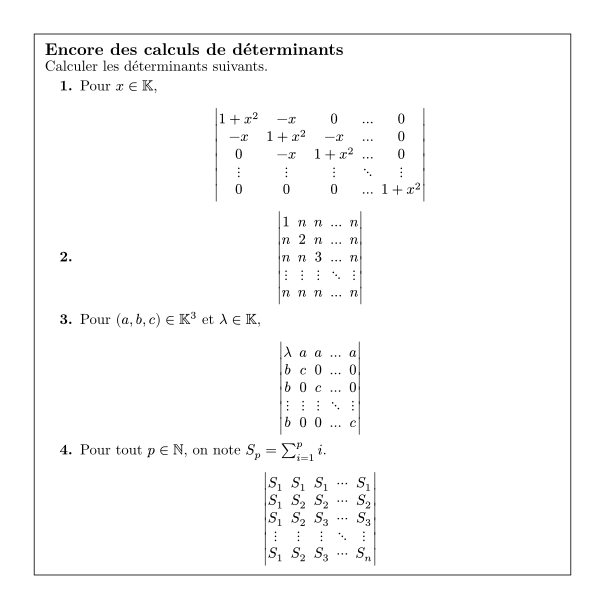
    Calculer les déterminants suivants.
    + Pour $x in bb(K)$,
      $
        mat(1+x^2, -x, 0, dots.h, 0; -x, 1+x^2, -x, dots.h, 0; 0, -x, 1+x^2, dots.h, 0; dots.v, dots.v, dots.v, dots.down, dots.v; 0, 0, 0, dots.h, 1+x^2; delim: "|")
      $
    + $
        mat(1, n, n, dots.h, n; n, 2, n, dots.h, n; n, n, 3, dots.h, n; dots.v, dots.v, dots.v, dots.down, dots.v; n, n, n, dots.h, n; delim: "|")
      $
    + Pour $(a,b,c) in bb(K)^3$ et $lambda in bb(K)$,
      $
        mat(lambda, a, a, dots.h, a; b, c, 0, dots.h, 0; b, 0, c, dots.h, 0; dots.v, dots.v, dots.v, dots.down, dots.v; b, 0, 0, dots.h, c; delim: "|")
      $
    + Pour tout $p in NN$, on note $S_p = sum_(i=1)^p i$.
      $
        mat(S_1, S_1, S_1, dots.c, S_1; S_1, S_2, S_2, dots.c, S_2; S_1, S_2, S_3, dots.c, S_3; dots.v, dots.v, dots.v, dots.down, dots.v; S_1, S_2, S_3, dots.c, S_n; delim: "|")
      $


// --- indication ---
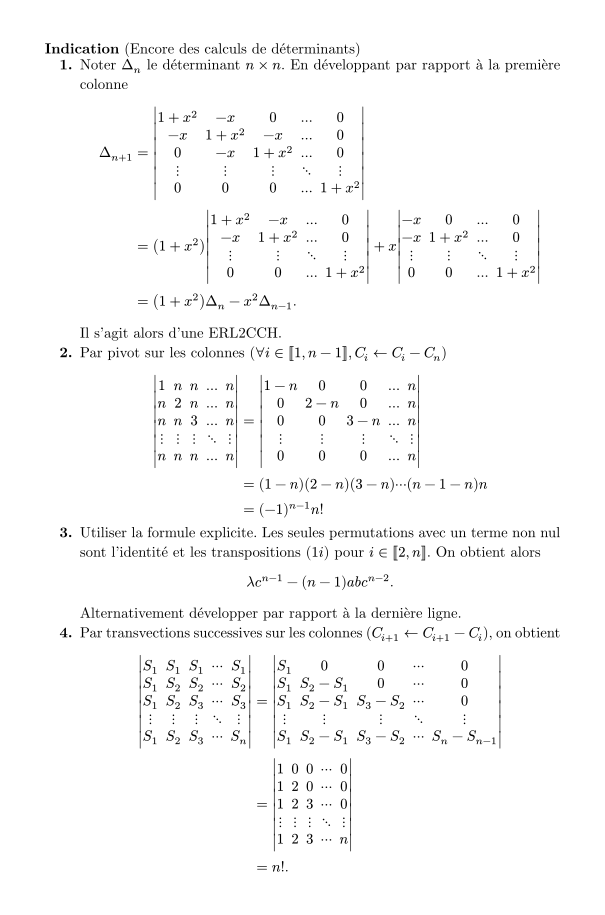
    + Noter $Delta_n$ le déterminant $n times n$. En développant par rapport à la première colonne
      $
        Delta_(n+1) & = mat(1+x^2, -x, 0, dots.h, 0; -x, 1+x^2, -x, dots.h, 0; 0, -x, 1+x^2, dots.h, 0; dots.v, dots.v, dots.v, dots.down, dots.v; 0, 0, 0, dots.h, 1+x^2; delim: "|") \
        & = (1+x^2) mat(1+x^2, -x, dots.h, 0; -x, 1+x^2, dots.h, 0; dots.v, dots.v, dots.down, dots.v; 0, 0, dots.h, 1+x^2; delim: "|") + x mat(-x, 0, dots.h, 0; -x, 1+x^2, dots.h, 0; dots.v, dots.v, dots.down, dots.v; 0, 0, dots.h, 1+x^2; delim: "|") \
        & = (1+x^2) Delta_n - x^2 Delta_(n-1) .
      $

      Il s'agit alors d'une ERL2CCH.
    + Par pivot sur les colonnes ($forall i in [| 1, n-1 |], C_i <- C_i - C_n$)
      $
        mat(1, n, n, dots.h, n; n, 2, n, dots.h, n; n, n, 3, dots.h, n; dots.v, dots.v, dots.v, dots.down, dots.v; n, n, n, dots.h, n; delim: "|") & = mat(1-n, 0, 0, dots.h, n; 0, 2-n, 0, dots.h, n; 0, 0, 3-n, dots.h, n; dots.v, dots.v, dots.v, dots.down, dots.v; 0, 0, 0, dots.h, n; delim: "|") \
        & = (1-n)(2-n)(3-n)dots.c (n-1-n) n \
        & = (-1)^(n-1) n!
      $
    + Utiliser la formule explicite. Les seules permutations avec un terme non nul sont l'identité et les transpositions $(1 i)$ pour $i in [| 2,n |]$. On obtient alors
      $ lambda c^(n-1) - (n-1) a b c^(n-2). $

      Alternativement développer par rapport à la dernière ligne.
    + Par transvections successives sur les colonnes ($C_(i+1) <- C_(i+1) - C_i$), on obtient
      $
        mat(S_1, S_1, S_1, dots.c, S_1; S_1, S_2, S_2, dots.c, S_2; S_1, S_2, S_3, dots.c, S_3; dots.v, dots.v, dots.v, dots.down, dots.v; S_1, S_2, S_3, dots.c, S_n; delim: "|") & = mat(S_1, 0, 0, dots.c, 0; S_1, S_2-S_1, 0, dots.c, 0; S_1, S_2 - S_1, S_3 - S_2, dots.c, 0; dots.v, dots.v, dots.v, dots.down, dots.v; S_1, S_2 - S_1, S_3 - S_2, dots.c, S_n - S_(n-1); delim: "|") \
        & = mat(1, 0, 0, dots.c, 0; 1, 2, 0, dots.c, 0; 1, 2, 3, dots.c, 0; dots.v, dots.v, dots.v, dots.down, dots.v; 1, 2, 3, dots.c, n; delim: "|") \
        & = n!.
      $
Une remarque ?
Une coquille, une erreur, une question sur cet exercice ?
Message envoyé, merci !
L'envoi a échoué — vous pouvez écrire à contact@jrax.fr.
Réponse à la question anti-robot incorrecte — le message n'a pas été envoyé (revenez en arrière pour retrouver votre saisie).