Développements en l'infini
- Dérivabilité
- Rapide
- Standard
- Indication
- MPSI
- PCSI
- DL1
Indication
Source Typst
// derivabilite-dlsqrt — CC BY-SA 4.0 — https://jrax.fr/exos/derivabilite/derivabilite-dlsqrt.html

// --- enonce ---
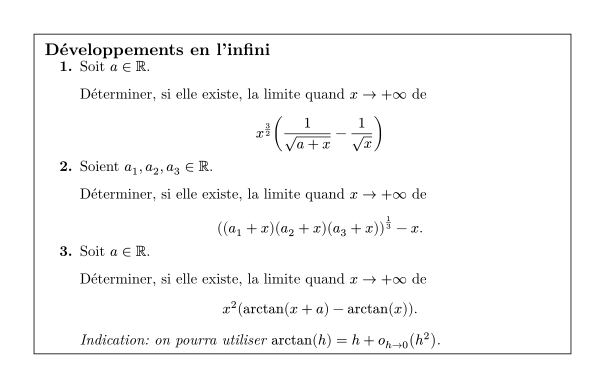
  + Soit $a in RR$.

    Déterminer, si elle existe, la limite quand $x -> +infinity$ de

    $ x^frac(3, 2) (frac(1, sqrt(a+x))-frac(1, sqrt(x)) ) $
  + Soient $a_1,a_2,a_3 in RR$.

    Déterminer, si elle existe, la limite quand $x -> +infinity$ de

    $ ((a_1+x)(a_2+x)(a_3+x))^(1/3) - x. $
  + Soit $a in RR$.

    Déterminer, si elle existe, la limite quand $x -> + infinity$ de
    $ x^2 (arctan(x+a)-arctan(x) ). $

    #emph[Indication: on pourra utiliser $arctan(h) = h + o_(h -> 0)(h^2)$.]


// --- indication ---
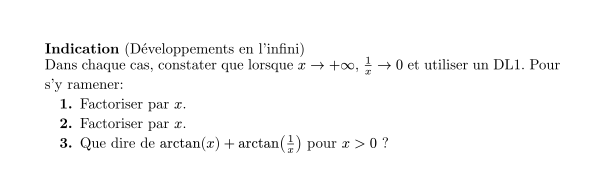
    Dans chaque cas, constater que lorsque $x -> + infinity$, $frac(1, x) -> 0$ et utiliser un DL1. Pour s'y ramener:
    + Factoriser par $x$.
    + Factoriser par $x$.
    + Que dire de $arctan(x) + arctan(1/x)$ pour $x> 0$ ?
Une remarque ?
Une coquille, une erreur, une question sur cet exercice ?
Message envoyé, merci !
L'envoi a échoué — vous pouvez écrire à contact@jrax.fr.
Réponse à la question anti-robot incorrecte — le message n'a pas été envoyé (revenez en arrière pour retrouver votre saisie).