Convexité et épigraphe
- Convexité
- Rapide
- Essentiel
- Indication
- MPSI
- PCSI
- quasi-cours
Indication

Source Typst
// convexite-epi — CC BY-SA 4.0 — https://jrax.fr/exos/convexite/convexite-epi.html

// --- enonce ---
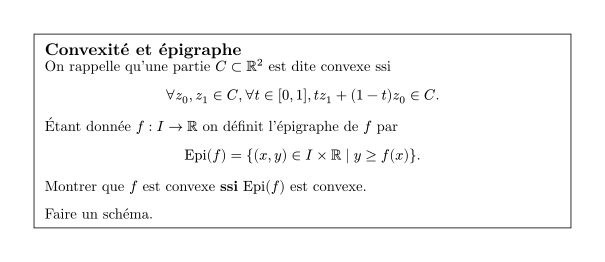
  On rappelle qu'une partie $C subset RR^2$ est dite convexe ssi

  $ forall z_0,z_1 in C, forall t in [0,1], t z_1 + (1-t)z_0 in C. $

  Étant donnée $f : I -> RR$ on définit l'épigraphe de $f$ par
  $ op("Epi")(f) = { (x,y) in I times RR divides y >= f(x)}. $

  Montrer que $f$ est convexe #strong[ssi] $op("Epi")(f)$ est convexe.

  Faire un schéma.


// --- indication ---
    Cf cours.
Une remarque ?
Une coquille, une erreur, une question sur cet exercice ?
Message envoyé, merci !
L'envoi a échoué — vous pouvez écrire à contact@jrax.fr.
Réponse à la question anti-robot incorrecte — le message n'a pas été envoyé (revenez en arrière pour retrouver votre saisie).