Vers le birapport
- Nombres Complexes
- Rapide
- Anecdotique
- Indication
- Solution
- MPSI
- PCSI
- géométrie
Indication
Solution
Source Typst
// c-protobirapport — CC BY-SA 4.0 — https://jrax.fr/exos/c/c-protobirapport.html

// --- enonce ---
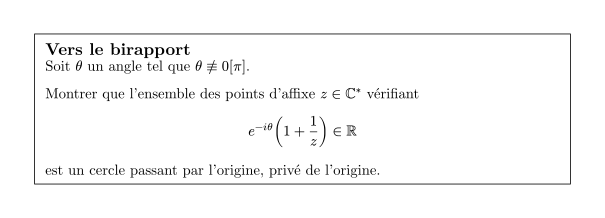
    Soit $theta$ un angle tel que $theta equiv.not 0 [pi]$.

    Montrer que l'ensemble des points d'affixe $z in CC^*$ vérifiant
    $ e^(-i theta)(1 + frac(1, z)) in RR $
    est un cercle passant par l'origine, privé de l'origine.


// --- indication ---
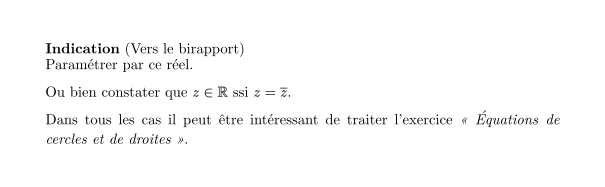
    Paramétrer par ce réel.

    Ou bien constater que $z in RR$ ssi $z = overline(z)$.

    Dans tous les cas il peut être intéressant de traiter l'exercice~#exoref("c-eqcercledroite").


// --- solution ---
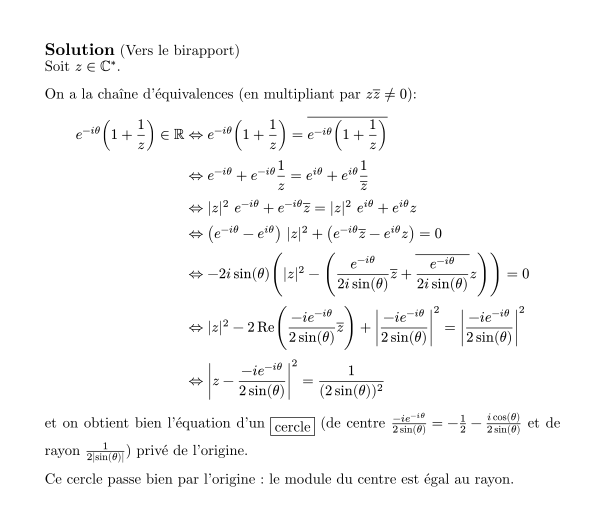
    Soit $z in CC^*$.

    On a la chaîne d'équivalences (en multipliant par $z overline(z) != 0$):

    $
      e^(-i theta)(1 + frac(1, z)) in RR &<=>e^(-i theta)(1 + frac(1, z)) = overline(e^(-i theta)(1 + frac(1, z))) \
      &<=>e^(-i theta) + e^(-i theta) frac(1, z) = e^(i theta) + e^(i theta) frac(1, overline(z)) \
      &<=>|z|^2 e^(-i theta) + e^(-i theta) overline(z)= |z|^2 e^(i theta) + e^(i theta) z \
      &<=>(e^(-i theta) - e^(i theta)) |z|^2 + (e^(-i theta) overline(z) - e^(i theta) z) = 0 \
      &<=>-2 i sin(theta) (|z|^2 - (frac(e^(-i theta), 2i sin(theta)) overline(z) + overline(frac(e^(-i theta), 2i sin(theta))) z )) = 0 \
      &<=>|z|^2 - 2 Re (frac(-i e^(-i theta), 2 sin(theta)) overline(z)) + abs(frac(-i e^(-i theta), 2 sin(theta)))^2 = abs(frac(-i e^(-i theta), 2 sin(theta)))^2 \
      &<=>abs(z - frac(-i e^(-i theta), 2 sin(theta)))^2 = frac(1, (2 sin(theta))^2)
    $

    et on obtient bien l'équation d'un #fbox[cercle] (de centre $frac(-i e^(-i theta), 2 sin(theta)) = -frac(1, 2) - frac(i cos(theta), 2 sin(theta))$ et de rayon $frac(1, 2 abs(sin(theta)))$) privé de l'origine.

    Ce cercle passe bien par l'origine : le module du centre est égal au rayon.
Une remarque ?
Une coquille, une erreur, une question sur cet exercice ?
Message envoyé, merci !
L'envoi a échoué — vous pouvez écrire à contact@jrax.fr.
Réponse à la question anti-robot incorrecte — le message n'a pas été envoyé (revenez en arrière pour retrouver votre saisie).